
Reprogrammed SimCells for antimicrobial therapy
Yun Dong; Xianglin Ji; Tao Dong; Yun Wang; Erik Bakkeren; Kevin R. Foster; Wei E. Huang*
* Corresponding author
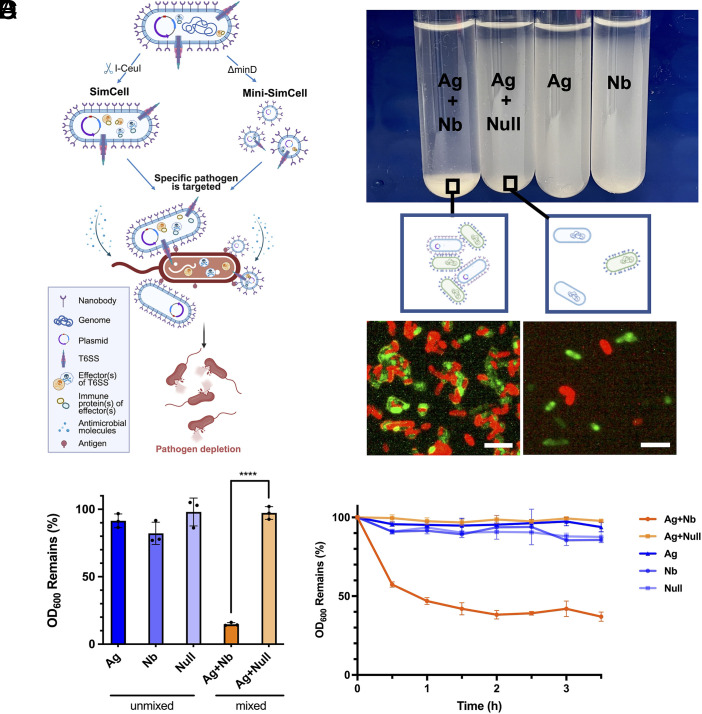
Chromosome-free SimCells and mini-SimCells were engineered to recognise and eliminate targeted bacteria. The study combines nanobody targeting with antimicrobial mechanisms, demonstrating selective activity against E. coli in laboratory experiments.
Key points
- Targeted recognition. Surface nanobodies help chromosome-free SimCells attach to selected bacteria.
- Two mechanisms. Contact-dependent toxin delivery is combined with local hydrogen-peroxide generation.
- Laboratory evidence. Repeated treatment reduced target bacteria about 1,000-fold in tested mixed communities.
Separating recognition from antimicrobial action
SimCells are engineered bacterial cells whose chromosomes have been removed, preventing replication while retaining machinery that can perform programmed tasks. Smaller mini-SimCells provide a related platform. In this study, the researchers equipped these cells with surface nanobodies—compact binding proteins that recognise a selected target—and antimicrobial modules.
The design separates two questions: can an engineered cell attach to the intended bacterium, and can it act once attached? Early experiments used a defined antigen–nanobody pair to test recognition. Later experiments changed the targeting component to recognise a naturally occurring surface protein on a multidrug-resistant E. coli strain. This progression moved the study from a controlled model towards a clinically relevant target.
Checking that targeting makes a difference
The researchers first tested the binding system in the parental bacterial chassis. Fluorescent labels distinguished the two cell populations under the microscope. Matched antigen and nanobody pairs formed aggregates, whereas controls lacking the matching binding component remained dispersed. This provided a visible check that recognition brought the cells into close contact.
That contact mattered for a type VI secretion system, or T6SS, which delivers toxic proteins into neighbouring bacteria. In liquid-culture tests with the parental chassis, the combination of binding and an active T6SS eliminated more than 84% of the target population relative to the negative control. An active T6SS without the nanobody did not produce the same effect. Subsequent experiments confirmed that engineered SimCells retained binding and antimicrobial activity after chromosome removal.
Two specialised populations, two timescales
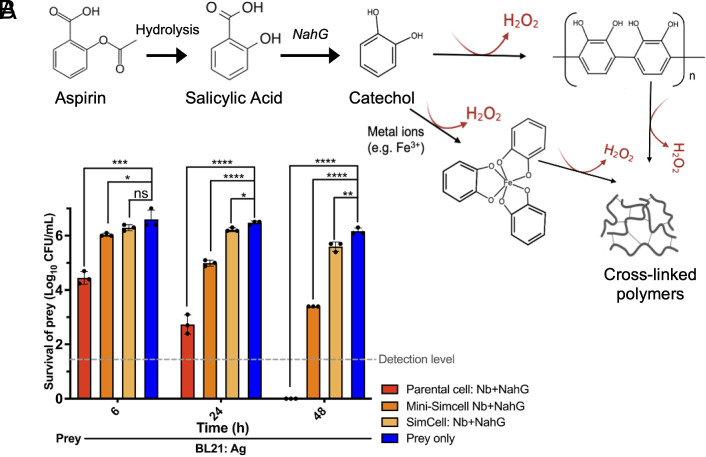
The combined treatment used a consortium of two mini-SimCell populations. One carried the contact-dependent T6SS machinery. The other carried the enzyme NahG, supporting a pathway in which aspirin-derived salicylate is converted to catechol. Catechol oxidation then generates hydrogen peroxide near the bound target. Both populations carried the targeting nanobody.
The timing was deliberate. The contact-dependent mechanism acted first, and aspirin was added later to initiate the chemical mechanism. This allowed the researchers to examine an early response followed by a more sustained effect, while reducing the chance that the oxidative products would interfere with the initial T6SS activity. Nonengineered mini-SimCells served as controls.
 View full size
Figure 4. The chemical pathway links aspirin-derived salicylate to catechol and hydrogen-peroxide production. The accompanying laboratory data compare target-cell survival with different engineered cell platforms.
From single-dose effects to selective depletion
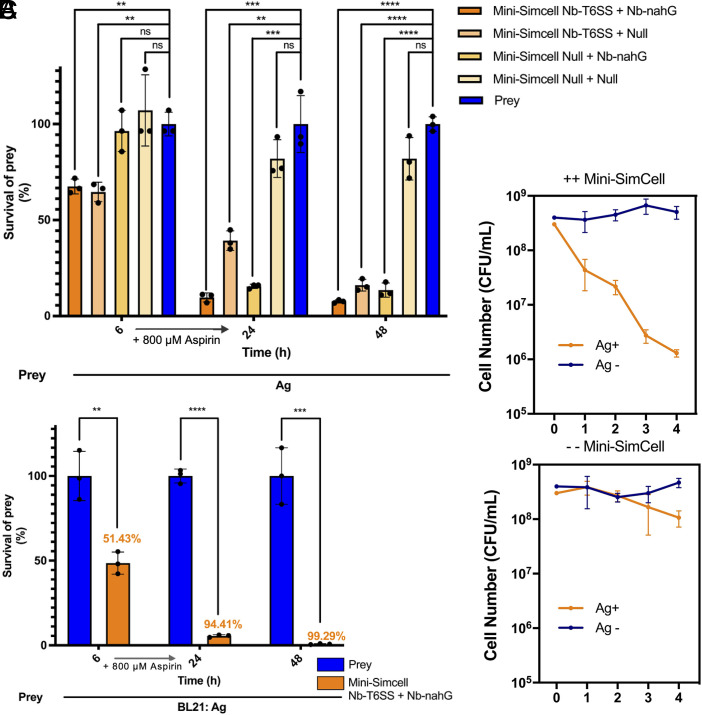
In the model-target experiment, a single dose of the dual-mechanism consortium eliminated 94.4% of target cells at 24 hours and 99.3% at 48 hours under the reported laboratory conditions. These figures describe the tested treatment and target population; they are not patient response rates.
A separate experiment asked whether treatment could remain selective in a mixed population. Target-bearing and nontarget E. coli were grown together, with repeated dilution and regrowth between treatments. After four sequential doses, the targeted population was reduced by approximately 1,000-fold relative to the control, while the nontarget population remained largely unchanged. This tested specificity during repeated population growth, beyond a single endpoint measurement.
 View full size
Figure 5. Single-dose experiments show the time course of target-cell elimination. Repeated treatment selectively reduces the antigen-bearing population in the mixed-community experiment shown on the right.
Testing a resistant clinical strain
For multidrug-resistant E. coli ST131, the researchers used nanobody Nb39 to recognise the native outer-membrane protein OmpA. Microscopy and flow cytometry confirmed binding before antimicrobial activity was evaluated. The adapted consortium achieved 97.19% elimination at 24 hours and 97.58% at 48 hours. The same strain resisted the conventional antibiotics tested in the study.
The contribution is a modular strategy: target recognition can be paired with distinct antimicrobial actions, and the binding component can be changed for a different bacterial target. The experiments establish activity in laboratory cultures, including a defined mixed community and a resistant strain. Delivery, persistence, host responses and therapeutic benefit in more complex biological settings still require evaluation before this can be considered a treatment for patients.
Publication
Reprogrammed SimCells for antimicrobial therapy
Yun Dong; Xianglin Ji; Tao Dong; Yun Wang; Erik Bakkeren; Kevin R. Foster; Wei E. Huang*
* Corresponding author
PNAS · 2026
Read the original publication