
Engineering artificial photosynthesis based on rhodopsin for CO(2) fixation
Weiming Tu; Jiabao Xu; Ian P. Thompson; Wei E. Huang*
* Corresponding author
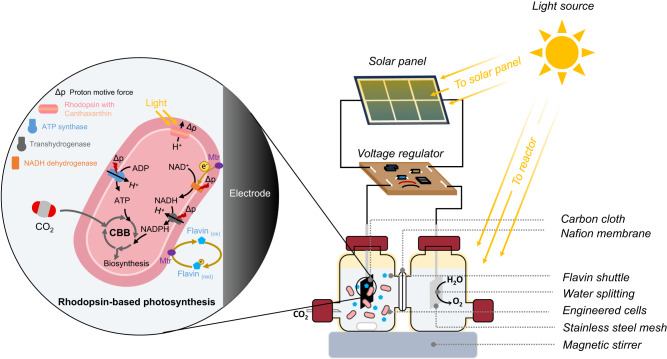
A rhodopsin proton pump and an extracellular electron-transfer pathway enable engineered bacteria to use light and electrical inputs for CO₂ fixation. The study connects photoelectrochemistry to cellular energy metabolism and biomass synthesis.
Key points
- Light harvesting. Rhodopsin supplies a light-driven proton gradient.
- Electron uptake. An introduced Mtr pathway links the electrode to cellular metabolism.
- Carbon assimilation. Isotope-labelled carbon and growth measurements assess CO₂ incorporation.
Connecting light, electrons and carbon
Ralstonia eutropha, also known as Cupriavidus necator, can fix carbon dioxide but is not naturally photosynthetic. The researchers introduced Gloeobacter rhodopsin and an extracellular electron-transfer pathway from Shewanella oneidensis to connect light harvesting and electrode-derived electrons with the host’s metabolism.
A photoelectrochemical system supplies electrons through water splitting. Rhodopsin generates a proton gradient that supports ATP formation and the regeneration of reducing power, linking these energy inputs to the cell’s carbon-fixation machinery.
Following the energy inside the cell
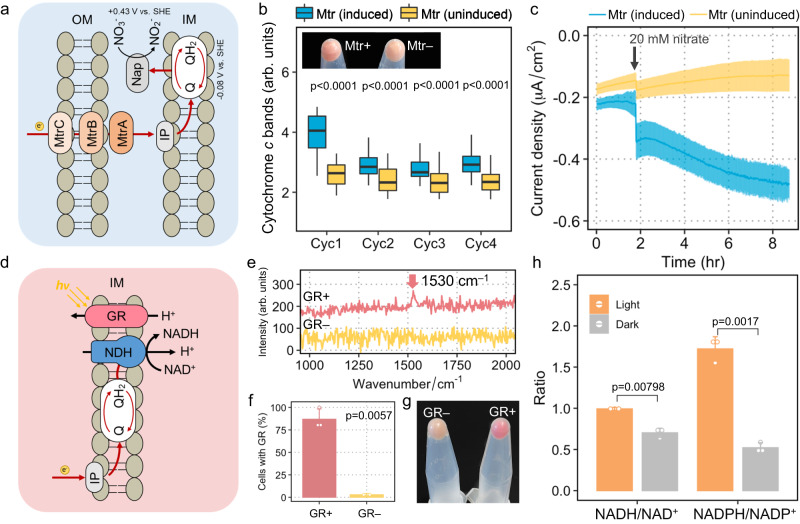
The team examined expression of the introduced components, electron uptake and changes in NADH and NADPH. Single-cell Raman measurements with heavy water provided a separate view of metabolic activity under different combinations of light and carbon supply. Together, these experiments tested the individual parts of the proposed pathway.
 View full size
Figure 2. The introduced electron-transfer and rhodopsin modules are assessed using Raman signals, electrode-current measurements and cellular reducing-power ratios.
Measuring carbon incorporation and growth
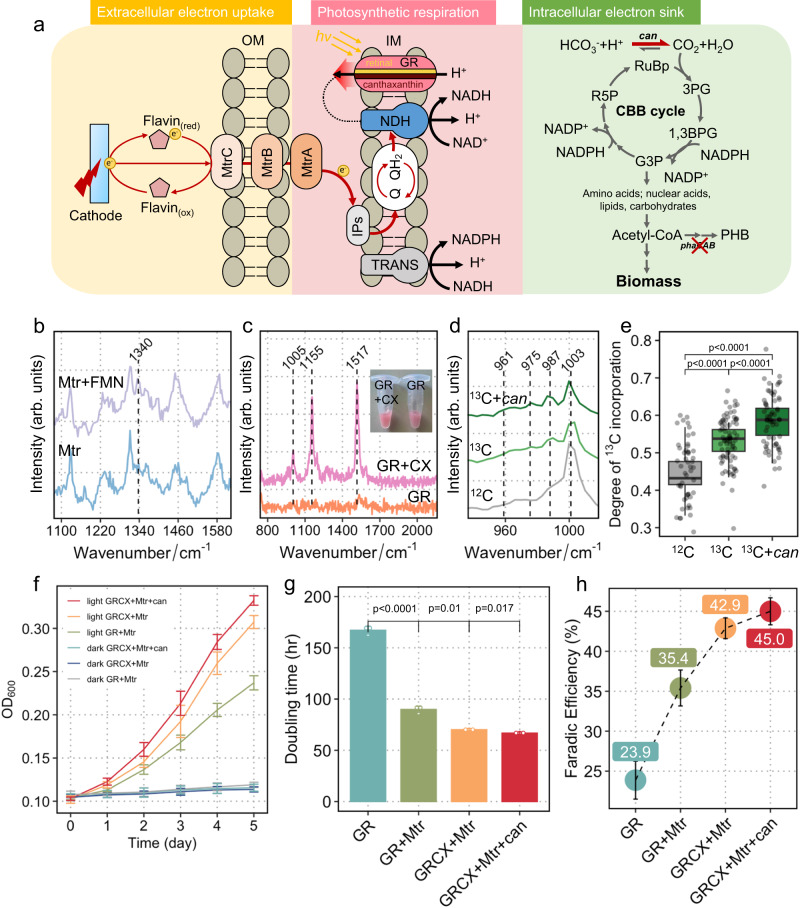
Carbon-13-labelled bicarbonate produced isotope shifts in cellular Raman spectra, providing evidence that the supplied inorganic carbon entered biomass. Growth experiments compared strains and illumination conditions. Adding canthaxanthin as a light-harvesting antenna and increasing carbonic-anhydrase expression further improved the system.
These measurements connect the engineered energy pathway to carbon assimilation. They do not establish an overall solar-energy conversion efficiency: the paper explicitly notes that such a calculation would require too many assumptions at this stage.
 View full size
Figure 4. Carbon-13 Raman shifts provide evidence of inorganic-carbon incorporation. Growth and strain comparisons examine the contributions of the engineered modules.
A modular route to biomanufacturing
The platform offers components that can be refined separately, including electron transfer, light harvesting and carbon metabolism. Longer operation and scale-up will require further work on energy balance and oxygen management. The study establishes a laboratory route towards light-supported biomanufacturing rather than a finished industrial process.
Publication
Engineering artificial photosynthesis based on rhodopsin for CO(2) fixation.
Weiming Tu; Jiabao Xu; Ian P. Thompson; Wei E. Huang*
* Corresponding author
Nature Communications · 2023
Read the original publication