
Engineering bionanoreactor in bacteria for efficient hydrogen production
Weiming Tu; Ian P. Thompson; Wei E. Huang*
* Corresponding author
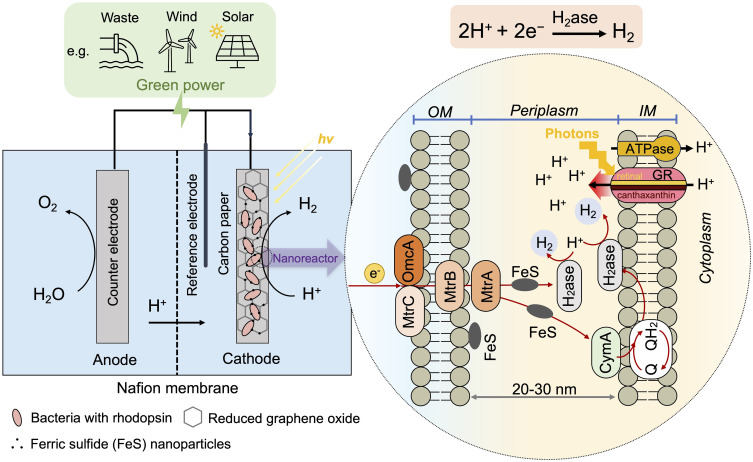
Engineering the narrow space between bacterial membranes brings electrons, protons and hydrogenase together for hydrogen production. The system combines biological catalysts with nanomaterials and is powered by both electricity and light.
Key points
- A nanoscale reactor. The bacterial periplasm provides a confined space for hydrogen synthesis.
- Coordinated inputs. Nanomaterials assist electron delivery; rhodopsin supports light-driven proton transport.
- Measured performance. The engineered system reached 80% Faradaic efficiency under the tested conditions.
Turning the cell envelope into a reactor
Hydrogenase enzymes combine protons and electrons to form hydrogen. In this study, the researchers engineered the periplasm of Shewanella oneidensis MR-1—the roughly 20–30 nanometre space between its inner and outer membranes—to bring these reactants close to the enzymes.
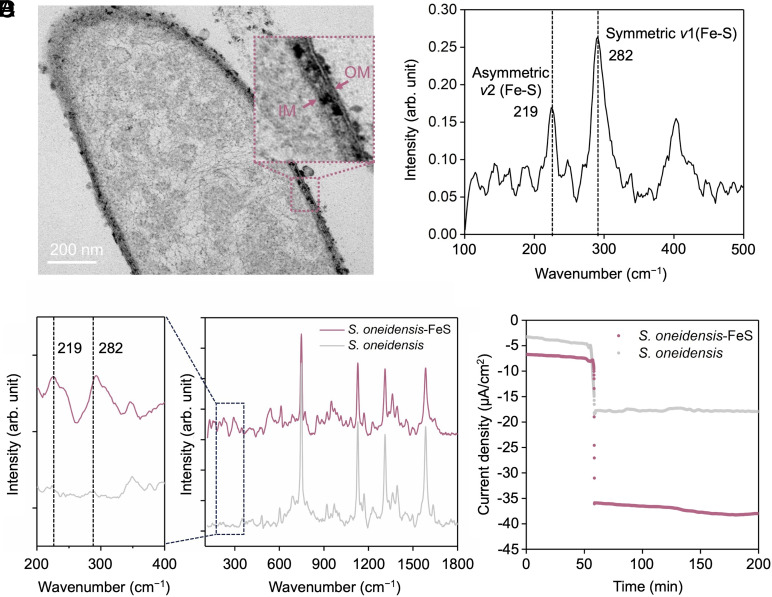
Reduced graphene oxide on the electrode, the native MtrCAB protein complex and biologically assembled iron-sulfide nanoparticles together support electron transfer into this compartment. Microscopy and Raman measurements examined the nanoparticles formed in and around the cell envelope.
 View full size
Figure 2. Electron microscopy and Raman analysis characterise the biogenic iron-sulfide nanoparticles; an electrochemical test assesses electron transfer.
Adding light-driven proton transport
The cells were engineered to express Gloeobacter rhodopsin and the light-harvesting antenna canthaxanthin. Illumination drives proton transport towards the periplasm, complementing the supply of electrons from the electrode. Increasing expression of the native [FeFe]-hydrogenase adds catalytic capacity.
Testing the combined system
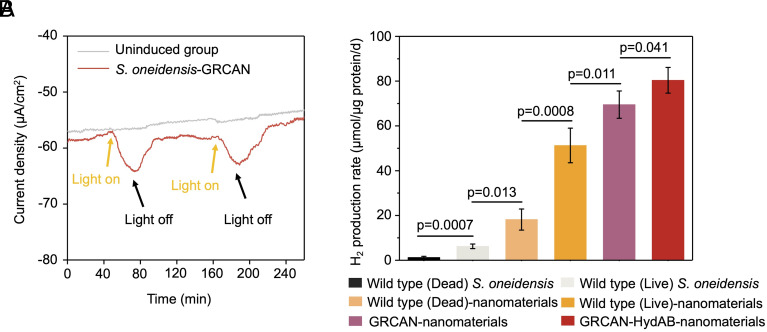
The study compared successive combinations of nanomaterials, rhodopsin, canthaxanthin and hydrogenase engineering. Under illumination at a cathode potential of −0.75 V versus the standard hydrogen electrode, the combined system produced 80.4 micromoles of hydrogen per milligram of protein per day, with 80% Faradaic efficiency.
Faradaic efficiency describes the proportion of transferred charge recovered in hydrogen; it is not an overall sunlight-to-hydrogen energy efficiency. The measurements demonstrate laboratory performance under the specified electrical and lighting conditions.
 View full size
Figure 5. Light–dark responses and hydrogen-production measurements compare the successive biological and material components of the engineered system.
A platform for further development
The work connects cell architecture, protein engineering and materials design in a single microbial electrosynthesis platform. The authors identify proton-flux dynamics and improved rhodopsins as areas for further investigation. Practical deployment will also require evaluation beyond these laboratory experiments.
Publication
Engineering bionanoreactor in bacteria for efficient hydrogen production.
Weiming Tu; Ian P. Thompson; Wei E. Huang*
* Corresponding author
PNAS · 2024
Read the original publication