
Synthetic Biology
Designing artificial photosynthetic pathways and reprogrammable SimCells to redefine industrial sustainability.
Research streams
Bio-Solar Conversion
Engineering rhodopsin light harvesting systems to enable non-photosynthetic chassis (Ralstonia eutropha) to capture light energy.
Chassis Design
SimCells provide a minimal biological environment for efficient execution of synthetic genetic circuits.
Light and carbon
Building a route from light to biomass
Artificial photosynthesis asks how cells that do not normally photosynthesise can use light to support carbon fixation. In our 2023 study, Ralstonia eutropha was engineered with a light-driven rhodopsin proton pump and an electron-transfer pathway from Shewanella oneidensis. These two modules connect light harvesting and external electron supply to the host’s metabolism.
A photoelectrochemical system supplies electrons, while rhodopsin builds the proton gradient used for ATP production. Together, these processes support the energy and reducing power needed to turn CO₂ into biomass. The work demonstrates a way to combine biological catalysts with electrical inputs; it is a laboratory platform for developing biomanufacturing processes, rather than an established industrial production system.
Tu et al. · Nature Communications · 2023
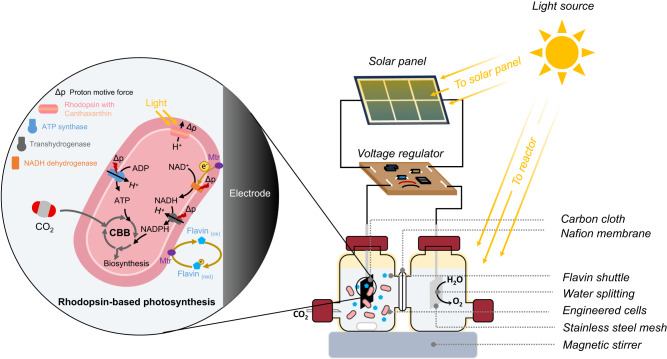
Figure 1. The system combines an external supply of electrons with light-driven proton transport. ATP and reducing power support the cell’s carbon-fixation pathway.
Tu et al. (2023)Original figureCC BY 4.0View larger ↗
Sustainable biomanufacturing
Using the cell envelope as a hydrogen reactor
In a complementary approach, the narrow space between the two membranes of Shewanella oneidensis was engineered as a bionanoreactor. The design brings electrons and protons close to hydrogenase enzymes, which catalyse hydrogen formation. Reduced graphene oxide and iron-sulfide nanoparticles help transfer electrons from an electrode into this cellular compartment.
Rhodopsin and its light-harvesting antenna supply additional protons under illumination, while increased hydrogenase expression improves catalytic capacity. The 2024 study shows how nanomaterials, protein engineering and cell architecture can work together to improve hydrogen production under defined laboratory conditions.
Tu et al. · PNAS · 2024
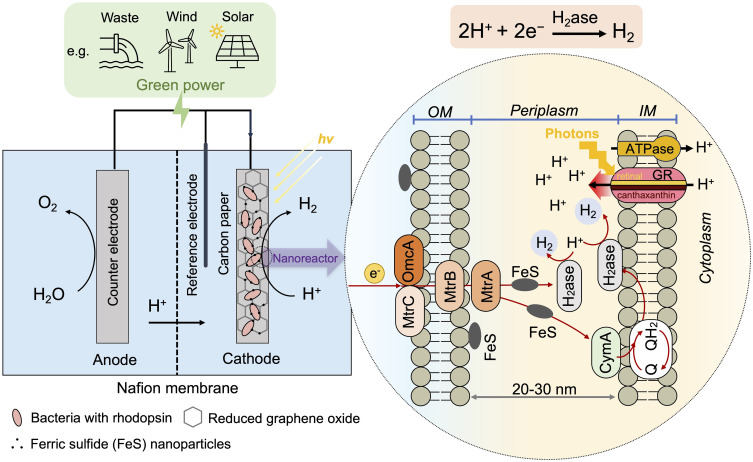
Figure 1. Electrons and light-driven protons converge in the periplasm, where hydrogenase catalyses hydrogen production. The diagram shows how biological and material components are connected.
Tu et al. (2024)Original figureCC BY 4.0View larger ↗
Synthetic biology for therapy
Programming recognition and local action
SimCells are chromosome-free bacterial cells that retain machinery for carrying out designed genetic programmes without continued cell division. This separates a useful biological task from the replication of a whole bacterium. Surface-displayed nanobodies can then provide a recognition module, helping the engineered cells bind a chosen target.
In the 2022 cancer study, anti-CEA nanobodies directed SimCells and mini-SimCells towards CEA-expressing colorectal cancer cells in vitro. A salicylate-responsive circuit converted salicylate into catechol to enhance the cancer-killing effect. These experiments connect molecular recognition with local biochemical activity; they establish an in-vitro proof of concept, not efficacy in patients.
Lim et al. · ACS Synthetic Biology · 2022
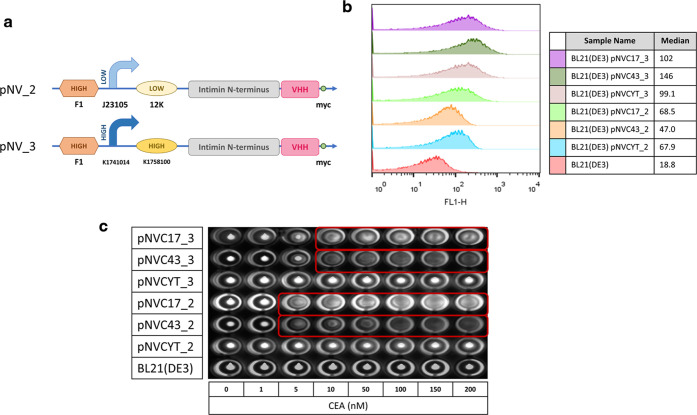
Figure 1. Surface-display constructs and binding assays establish the recognition component in the parental bacterial chassis. This figure concerns nanobody display and antigen binding, rather than treatment outcomes.
Lim et al. (2022)Original figureCC BY 4.0View larger ↗
Featured publications
- Engineering artificial photosynthesis based on rhodopsin for CO2 fixationTop 25 Life Sciences
Nature Communications (2023)
PNAS (2024)
PNAS (2020)
ACS Synthetic Biology (2022)